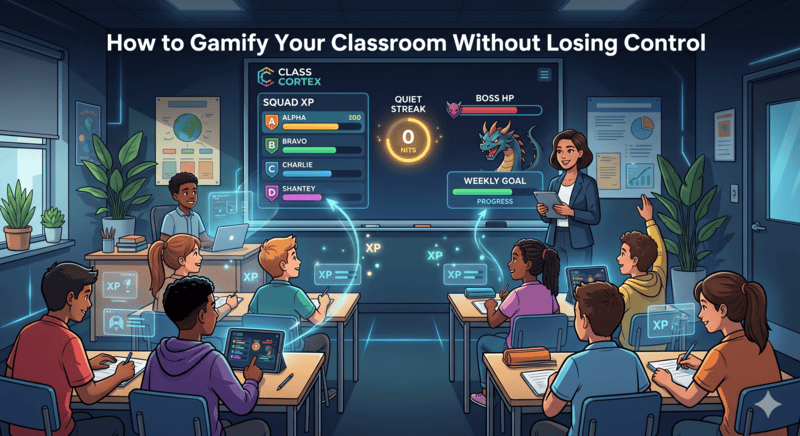
There is a common misconception among educators that "gamification" simply means playing games in class. It brings to mind images of students shouting over a Kahoot podium while the teacher desperately tries to lower the volume.
True classroom gamification isn't a distraction from the lesson; it is a structural overlay that runs in the background, reinforcing the behaviors you actually want to see. When implemented effectively, particularly in Years 5 through 10, it creates a self-regulating environment where students manage their own engagement.
Here is a practical framework for gamifying your room without sacrificing your sanity.
1. Establish a clear economy (XP)
Before you introduce any monsters, avatars, or games, you need a currency. Experience Points (XP) are the gold standard because students intuitively understand them.
The trick is consistency. If XP is handed out randomly, it loses value. Set clear, achievable milestones. In Class Cortex, you can set a "Weekly XP Goal." Tell your class: "If the squad hits 500 XP by Friday, we run a Boss Battle." Suddenly, completing standard worksheet activities or arriving to class on time has tangible, collective value.
Pro-Tip: Leverage Squad Dynamics
Don't just track individual XP; group your students into Squads (Alpha, Bravo, Charlie). Peer accountability is a powerful force. When a student knows their off-task behavior might cost their squad the weekly reward, they are far more likely to self-correct.
2. Automate the boundaries
Gamification fails when the teacher has to constantly pause teaching to administer points or penalties. It breaks the flow of the lesson and turns you into a scorekeeper rather than an educator.
You need tools that enforce the rules for you. This is why we built the Sonic Defence Engine into Class Cortex. Instead of shushing the room, you set the noise monitor to your desired threshold. If the class gets too loud, the system triggers a visual alert and automatically deducts XP. The room polices itself, and you don't have to raise your voice once.
3. Use "Boss Battles" as the carrot, not the meal
A Boss Battle is a high-energy, high-stakes review session. If you do it every single day, the novelty wears off, and the energy levels will exhaust you.
Treat Boss Battles as the ultimate reward. Reserve them for the last 15 minutes of a Friday lesson or the end of a difficult unit. When you project the Boss on the smartboard and students realize they have to answer subject questions correctly to defeat it, you will see a level of focus you didn't know your class was capable of.
4. The Quiet Streak
Gamification isn't just for active tasks; it works wonders for quiet, focused work. Create a streak system for absolute silence.
In Class Cortex, the Quiet Streak tracker automatically awards bonus XP for every consecutive silent minute. It flips the psychology of the room. Instead of viewing silence as a punishment, the students view it as a cooperative challenge. You'd be amazed how fiercely a Year 9 class will defend a 10-minute silence streak.
The Takeaway
Gamification should make your life easier, not harder. By establishing clear rules, automating your boundaries, and using high-energy games strategically, you can create a classroom culture that is highly engaged and perfectly under control.